A birthday bringing together several generations, a wedding to imagine at your own pace, a family reunion that deserves more than just a table at a restaurant: can you privatise a historic estate to turn these moments into a real stay? Yes, in many cases. But behind the word «privatisation», the realities differ greatly from one property to another. The essential thing is to choose a place whose heritage charm genuinely matches the practical needs of your event.
A historic estate is more than just a pretty facade. It's an atmosphere, its spaces, a park, sometimes bedrooms where the party can continue, and, above all, a more intimate way of hosting. For the experience to remain as seamless as it is elegant, it's important to look beyond the images and ask the right questions from the very first conversation.
What does the privatisation of a historic estate cover?
To privatise an estate generally means to reserve its exclusive use for a defined period. This exclusivity can apply to the entire property or only to certain areas: reception rooms, gardens, the courtyard, accommodation, or even a room suitable for business meetings.
The degree of privatisation needs to be carefully specified. Some venues offer exclusive use of the reception area while also welcoming other guests in a separate wing. Others allow a group to have all the rooms and common areas to themselves, creating the rare feeling of being at home in a character property. There is no universal formula: the one that suits will depend on the type of celebration, the number of guests and the desired level of intimacy.
For a wedding, the exclusivity of the park and reception venues allows you to experience the day without encountering any other guests. For a family reunion or a birthday, the option to stay overnight profoundly changes the pace of the weekend: you have breakfast together, conversations are prolonged, and no one has to drive home after dinner. For a seminar, it offers a focused setting, away from the usual hustle and bustle, while preserving the comfort of the participants.
Can a historic estate be privatised for every occasion?
The answer depends less on the nature of your event than on the capacity of the venue and its reception facilities. An estate might be perfect for a family reception of thirty people and less suitable for an evening party of two hundred guests. Conversely, a large property might offer vast outdoor spaces but a more limited number of beds.
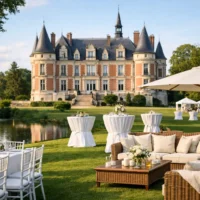
Weddings naturally fit into this type of setting. A humanist ceremony under the trees, a cocktail reception in a garden, dinner in a room with a strong character, and then a night on the estate make up a coherent day, without unnecessary travel. However, it is important to check the music end times, the arrangements in case of rain, and the installation possibilities for suppliers.
Family gatherings also benefit from being organised in a private venue. A family home, even a much-loved one, often requires a lot of preparation from its hosts. In a country estate, everyone can enjoy a well-maintained setting without any one guest bearing the sole burden of hospitality. Children have space, older relatives can rest nearby, and shared moments happen naturally between meals, walks, and evenings.
For businesses, the historical character offers a welcome change of pace. A workday spent in a bright lounge, followed by dinner and an overnight stay, encourages simpler exchanges than a succession of standardised rooms. Here too, the setting is not enough: the quality of the connection, the presentation equipment, the table configuration and the privacy of the spaces remain crucial.
Heritage brings charm, but also a framework to respect
Choosing an old dwelling means accepting that its identity is not that of a purpose-built events venue. The stairs, old floors, fireplaces, panelling, or gardens require particular attention. These constraints do not diminish the experience: they preserve its beauty.
Certain decorations may require prior approval. Candles, fireworks, suspended installations, or significant structures in the park are sometimes restricted for safety or conservation reasons. Similarly, accessibility should be addressed directly if people with reduced mobility, young children or very elderly guests are participating in the event.
A reputable venue will clearly explain what is possible, what requires adaptation, and what cannot be considered. This transparency is invaluable. It allows for the creation of a reception that is faithful to your desires without putting the venue or its heritage under strain.
Questions that turn a nice visit into a good choice
During a first visit, emotion counts. It helps you to know if you can see yourself living there. But it must be accompanied by a very practical assessment of the arrangements. Ask if you will be the only occupants of the estate, which spaces are included, and at what time they will be accessible.
The accommodation capacity deserves the same accuracy. How many people can sleep on site? Are the rooms spread across several buildings? Are there comfortable options for families, couples, or guests who want more independence? An event remains more pleasant when the sleeping arrangements truly match the group's composition.
Also, find out about the catering. Some venues work with selected partners, while others offer more freedom in choosing your caterer. You'll need to know the conditions for kitchen access, the equipment included, the service, the timings, and any corkage fees. These details will directly impact both the atmosphere and the budget.
Finally, observe the transitions between spaces. Where do guests arrive? Where can a cocktail reception be held if the weather turns? Where can children play without wandering off? What is the distance between the reception and the bedrooms? In a well-thought-out estate, these transitions are natural. They prevent organisation from taking precedence over the pleasure of hosting.
To forecast the budget as a whole
Privatisation represents an investment that goes far beyond the advertised rental price. It may include rooms, furniture, certain outdoor spaces, on-site staff, or setup and dismantling times. However, each property has its own specific arrangements.
To compare two proposals, it is useful to look at what is actually included for the entire duration of the stay. An offer that appears higher may include accommodation, an extra night, breakfast, or a large part of the furniture. Another may request additional services that quickly add up: cleaning, a caretaker, heating, security, equipment rental, or extended hours.
The duration is also essential. A privatisation lasting a single day suits certain receptions. A full weekend, on the other hand, offers another luxury: that of not having to cram everything into a few hours. Friday allows for a relaxed arrival, Saturday hosts the celebration, and Sunday makes room for a final lunch or a stroll before departures.
Anticipate without losing spontaneity
The most sought-after historical venues often get booked up well in advance, particularly for Saturdays during the fine weather and for holiday periods. Starting your search early gives you more choice and allows time to envision a celebration that suits you.
This anticipation does not require everything to be frozen. On the contrary, it allows the essential to be secured – the date, the venues, the accommodation, and the main timings – before refining the details. Flowers, music, the menu, and the staging find their rightful place more easily once the framework has already been chosen.
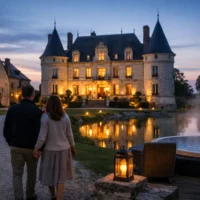
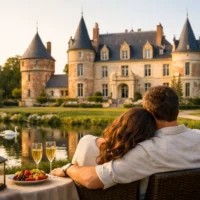
At Château de Quesmy, the appeal of a private hire lies precisely in this combination of a characterful property and accommodation designed for group stays: celebrating, staying overnight and making the most of your time together can all be part of the same experience.
Before you make up your mind, just imagine the end of your day. The last guests head up to their rooms, conversations mellow into a gentle hum, and the estate settles into peace without anyone having to rush off. It's often in this freedom to prolong the moment that private hire truly comes into its own.


 Français
  English (UK)
  Deutsch
  Nederlands
  Español