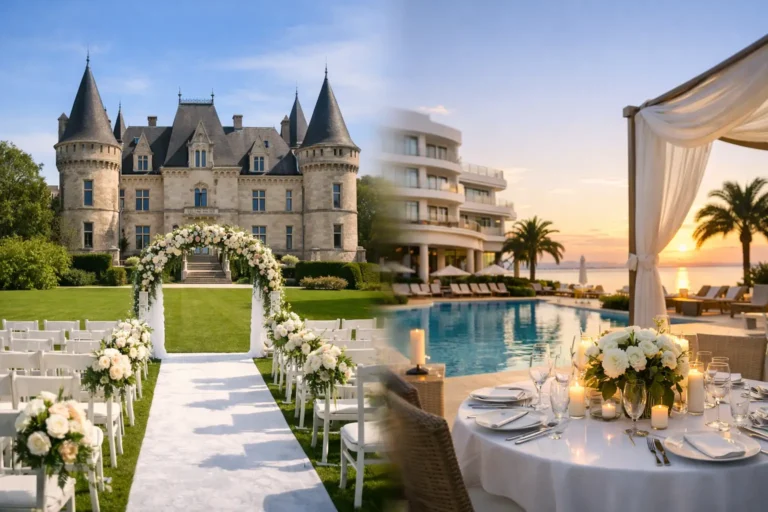
The setting sets the tone for your day long before guests arrive. Between a Château or hotel for a wedding, The choice isn't simply a matter of decor: it dictates the pace of the weekend, the intimacy of the reception, the comfort of your loved ones, and how you'll experience every moment. Some couples dream of a large house to share until the next day. Others seek the reassuring simplicity of a hotel. Both options can be wonderful, provided you choose the one that truly suits your story.
Château or hotel for a wedding: two very different experiences
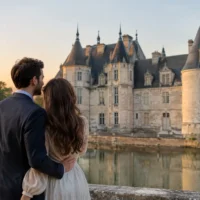
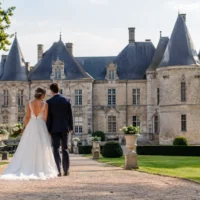
A castle naturally creates the impression of a parenthesis. The arrival via the drive, the ancient architecture, the reception rooms, the gardens and the views over the countryside create an atmosphere that doesn't need to be overstated. The place becomes a part of the memory. It is particularly suitable for couples who wish to bring their families together in a setting that is both elegant, lively and personal.
The hotel offers another form of comfort. Its spaces are often organised to accommodate events with immediate efficiency: reception, rooms, catering, parking and on-site teams. For a celebration concentrated on one evening, or when many guests are coming from afar, this clarity can be invaluable. Everyone knows where to sleep, what time to arrive, and who to turn to.
The real difference, therefore, lies less in the prestige of the building than in the experience sought. A hotel often accompanies a reception. A privatised estate can accommodate a genuine family time, from the preparations to the next day's breakfast.
The atmosphere: a remarkable setting or the comfort of a hotel address
If you imagine a secular ceremony in a park, a cocktail reception on a terrace, photos amongst the trees, and conversations that linger in characterful lounges, the château has an obvious advantage. It offers several settings without requiring travel. This variety is also useful in case of changing weather: a reception can maintain its coherence by moving from a garden to a warm interior.
However, the château requires looking beyond the images. Not all venues have the same contingency spaces, accessibility, or flexibility for providers. A heritage site has its charm, but also its constraints: stairs, neighbourly hours, protected areas, or installation rules. These elements are not defects when they are anticipated. They simply contribute to a more attentive organisation.
The hotel can appeal to couples who prefer a more contemporary, urban, or minimalist ambiance. It is sometimes better suited to an evening reception, a dinner of a controlled size, or a wedding where guests favour the comfort of a full hotel service. Its decor may be less exclusive, but it leaves more room for chosen staging: flowers, lighting, stationery, and furniture can then express your world.
Sleeping over: a detail that changes the whole party
Accommodation is often the deciding factor. When some of your loved ones sleep over at the reception venue, the day doesn't abruptly end after dinner. Preparations begin without a stressful journey. Grandparents, ushers, and friends who have travelled from afar remain close by. The next day, a shared brunch or breakfast prolongs the joy with a rare gentleness.
In a castle, the bedrooms and apartments contribute to this feeling of an inhabited home. Guests are no longer merely present at the reception: they are part of the stay. This approach is particularly well-suited to intimate weddings, families spread across several regions or countries, and celebrations planned over two days.
A hotel offers a different advantage: it can provide a significant number of rooms, sometimes with various categories and more individualised booking. For a large wedding, this simplifies the allocation of guests. Nevertheless, check what «sleeping on-site» really means. Are the rooms reserved exclusively for your group? Are they located in the same building as the reception room? Are the prices, arrival times, and breakfast adapted to your schedule?
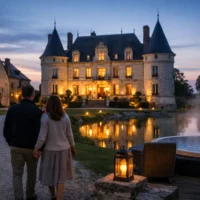
At Château de Quesmy, the appeal of a wedding at the estate lies precisely in this continuity: celebrating in a setting full of character and then welcoming your loved ones to stay the night, without separating the celebration from the experience of the stay.
Budget: compare the overall cost, not just the rental price
A hotel sometimes displays a simpler package to understand: room hire, per-person menu, overnight stays and options. This structure is reassuring for establishing an initial budget. It can also become more expensive if you wish to personalise every detail or if certain services are imposed.
The castle frequently operates with a privatisation option, offering greater freedom of choice. This flexibility allows clients to select their own caterer, florist, photographer, or entertainment according to their priorities. However, it requires careful attention to what is included: furniture, cleaning, crockery, staff, security, corkage fees, overtime, brunch, and accommodation.
To make a fair comparison, ask each venue the same question: what would the total cost be for our number of guests, including dinner, drinks, necessary rooms, and the following morning? An attractive venue hire price doesn't tell the whole story. Conversely, a venue privatisation that includes multiple spaces and overnight stays may represent better value than it initially appears.
Also, leave room for choices that truly make your wedding. Music that reflects you, a dinner your guests will remember, beautiful evening lighting, or a comfortable room for parents sometimes matter more than a very expensive decorative detail.
Organisation: Creative freedom or integrated support
The choice between a château and a hotel depends a lot on your relationship with organisation. If you like to imagine a bespoke reception and choose local partners, a château can offer you an exceptional playground. You will be able to build a day at your own pace: arrival the day before, family lunch, outdoor ceremony, dinner in a lounge, return to calm and brunch the next day.
This freedom requires a little more coordination. You need to check supplier access, assembly times, contingency plans, electrical supply, parking, and the potential presence of a coordinator. A good venue will guide you on the realities of the site and help you avoid simple mistakes, without erasing your personality.
The hotel is more suited to couples who wish to limit the number of people they need to liaise with. An events team can centralise catering, accommodation and the running of the evening. This is a convenient solution when time is short or your daily life leaves little room for planning. The downside is a sometimes more limited scope for manoeuvre on timings, suppliers or the use of spaces.
The questions that reveal the right place
During the visit, don't just ask if the date is available. Imagine your day hour by hour. Where will the bride and groom get ready? Where can children have a break? What happens if it rains during the cocktail hour? Until what time is music allowed? And most importantly, where will your guests naturally meet up the next day?
Also ask the venue about the number of beds actually available, the conditions for private hire, and accessibility for people with reduced mobility And the possibilities for restoration. Ask to see the spaces at the time you will be celebrating. A garden at midday, a hall at twilight, and a room in the morning do not tell the same story.
The right choice isn't necessarily the most spectacular venue or the simplest one on paper. It's the one where you can see yourself hosting the people who matter, without feeling like a guest at your own wedding. If the idea of extending the celebration with coffee, brunch, and a few last laughs already touches you, look for a venue that makes space for the day after.


 Français
  English (UK)
  Deutsch
  Nederlands
  Español